Ice Maker Repair
Sub-Zero ice maker stopped in a Phoenix heat wave: water, scale or the module?
Phoenix water is hard and a clear-ice module is the most water-sensitive thing in the kitchen. This walks through the checks in order — supply, filter, fill volume, mould and sensors — so you can tell a plumbing problem from a machine problem before you call.
An ice maker that stops in the middle of a Phoenix summer feels like a machine failure and usually is not one. Valley water is hard, a clear-ice module is the most water-dependent component in the kitchen, and most of the faults that look like a dead ice maker are about water arriving badly rather than ice being made badly. The checks below run in the order a technician runs them, which is also the order from cheapest to most involved.
Start with whether water is arriving at all
Before anything else, establish that the machine has water to work with.
- Find the shutoff and confirm it is open. On undercounter machines it is usually under the adjacent sink; on built-ins it is often behind a nearby cabinet or in the basement of the run. A valve nudged closed during plumbing or a dishwasher swap is a genuinely common cause of an ice maker that quit for no apparent reason.
- Check the dispenser or a nearby tap on the same line. Weak flow everywhere points at the supply or the filter, not the ice maker.
- Look for a bowed or crimped line behind the unit, especially if anything has been pulled out for cleaning recently.
If there is no water, stop here — nothing further down this list matters until there is.
Then the filter, the fill, and the shape of the cubes
Cube shape is diagnostic, and it is the part owners can read themselves.
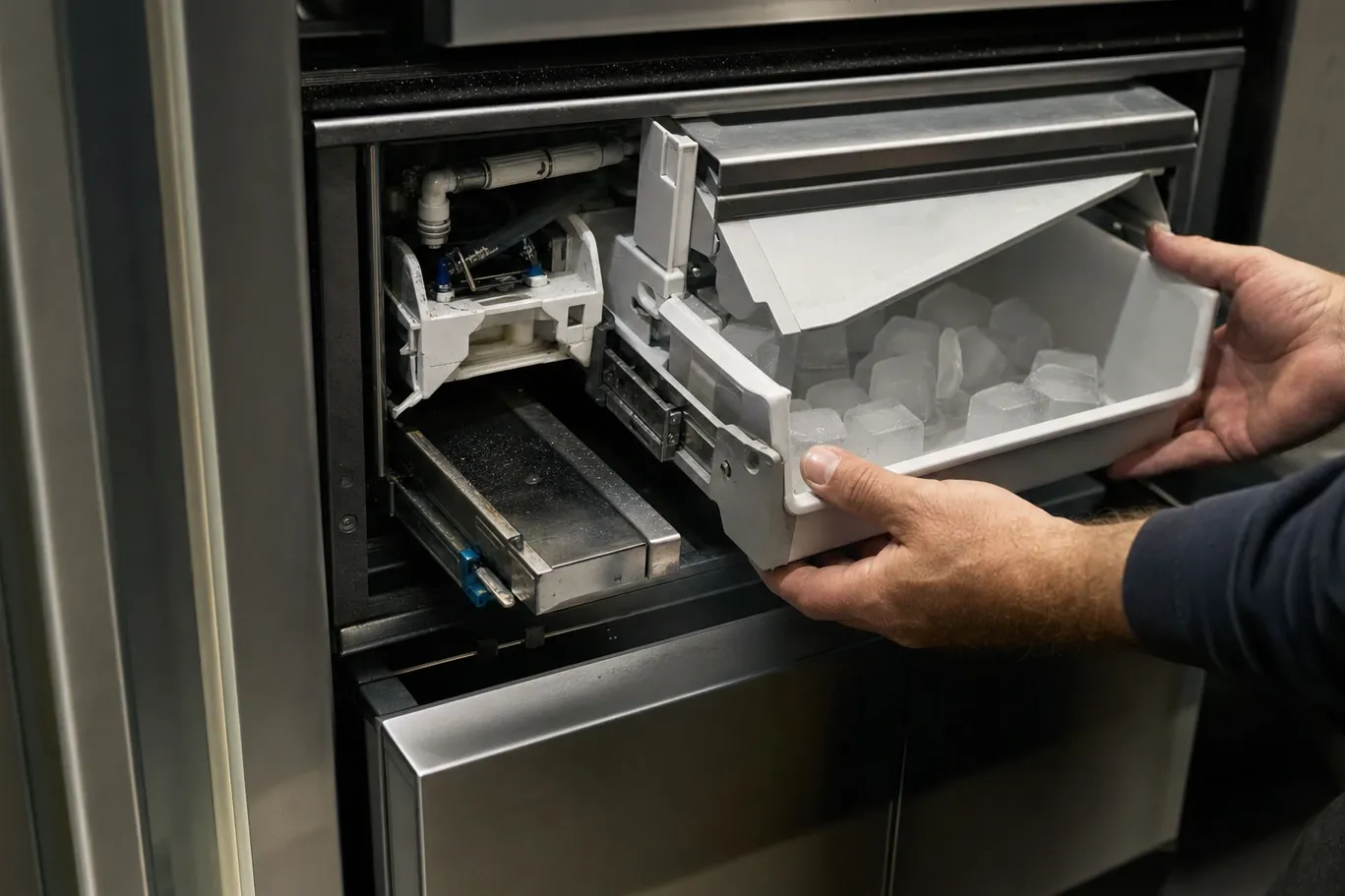
Small, hollow or milky cubes mean the mould is not filling properly or is not releasing cleanly. A filter that has not been changed in a couple of years is the first suspect, and in this water a filter reaches the end of its useful life well before the label says so. After a new filter, run three or four batches before judging: the first cubes after any water work are never representative.
Cubes that are the right size but cloudy are usually mineral, not air. Clear ice is made slowly on purpose so that dissolved solids stay in the water being flushed away; when the mould is scaled, that process stops working and the minerals end up inside the cube.
No cubes at all, with the mould dry, sends you back to the supply. No cubes with water sitting in the mould points at the harvest side — a heater, a motor, or a control that is not calling for harvest.
What scale actually does inside the machine
This is the part that is specific to living here. Hard water leaves a chalky film on three surfaces that matter: the mould itself, the fill tube, and the sensors.
On the mould, scale insulates. Ice takes longer to form, longer to release, and the cycle stretches out until production quietly halves. Owners rarely notice the slide because it takes months — what they notice is a bin that no longer keeps up with a party.
In the fill tube, scale narrows the passage and reduces the volume dropped into the mould each cycle. That is the mechanism behind hollow and undersized cubes even when the filter is new.
On sensors, film makes the machine unreliable rather than dead: it may keep making ice into a full bin, or stop with the bin half empty, because what the control thinks it is measuring is under a layer of mineral.
Descaling with the manufacturer-approved cleaner, rather than vinegar poured hopefully into the reservoir, is the fix — and on an undercounter clear-ice machine it is maintenance, not repair. Somewhere between yearly and twice-yearly is realistic on this water.
Drains, bins and the smell test
Undercounter machines drain, and drains block. Water backing up under the unit, cubes fusing into one lump in the bin, or a musty smell that survives a bin wash all point at the drain rather than the module. The line gets flushed and traced; the pump gets tested rather than replaced on suspicion.
Fusing is worth understanding because it panics people. Cubes weld together when they are repeatedly warmed and refrozen — a fill tube dripping past the mould between cycles, a door seal letting warm air in, or a bin that has been sitting through several defrost cycles. It is a symptom of something upstream, not a fault of the ice itself.
When to stop and call
Three findings are worth handing over rather than chasing.
The first is a fill valve you suspect but cannot measure. Valves fail partly open or partly closed, and confirming that means measuring fill volume against the specification rather than watching it and forming an impression.
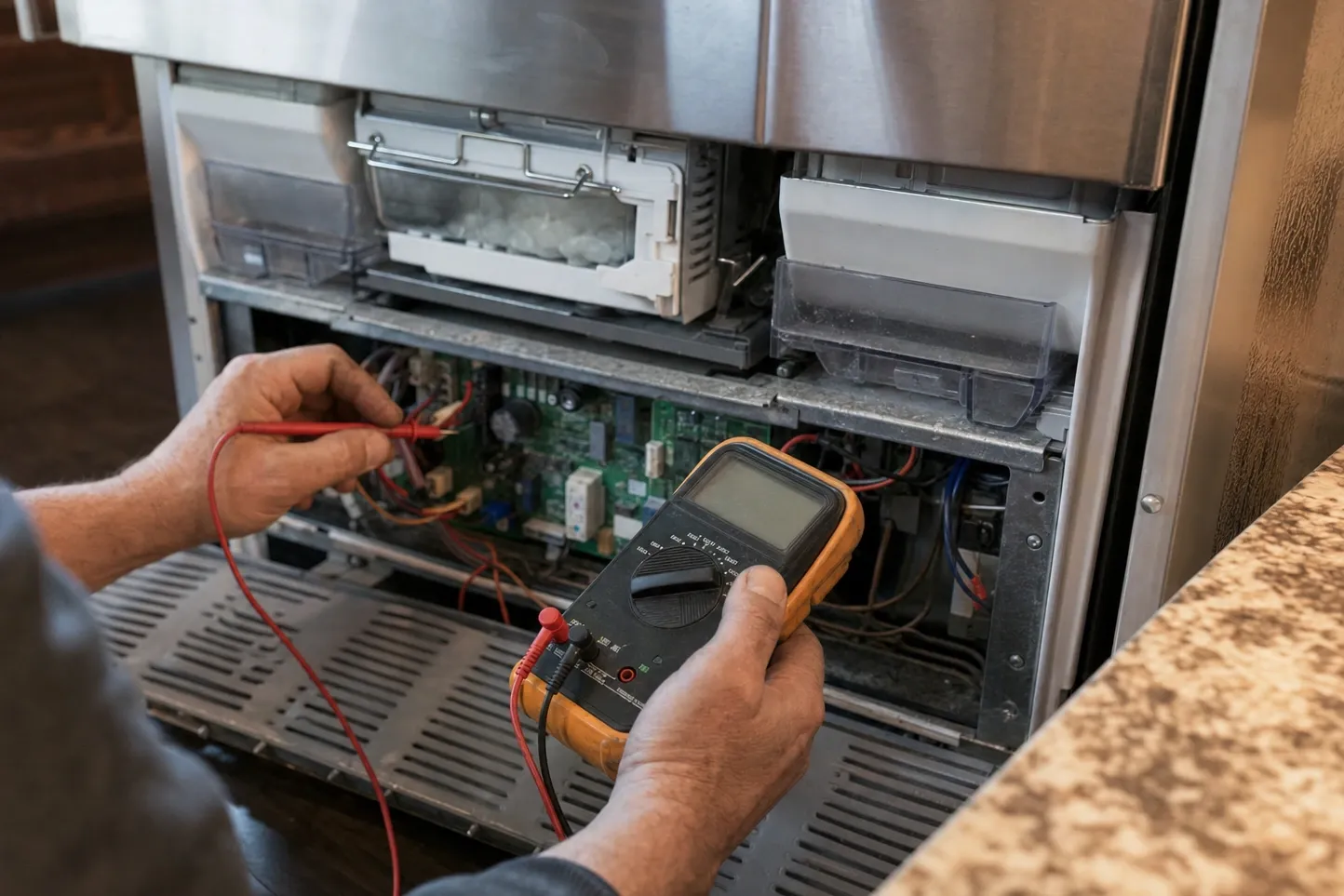
The second is anything electrical behind the module — a harvest heater, a thermistor, or a control board. These are testable parts with published resistance values, and replacing them by elimination gets expensive quickly.
The third is an ice maker inside a freezer that is itself not holding temperature. Fix the box first. An ice maker in a compartment sitting at fifteen degrees will produce soft, fusing, disappointing ice no matter how clean the mould is, and a technician who replaces the module before checking the compartment has solved the wrong problem.
Follow-up questions
- How much ice should a built-in Sub-Zero ice maker actually make in a day?
- Far less than people expect. A freezer-mounted ice maker in a built-in typically produces a few pounds a day, and an undercounter clear-ice machine several times that. In a heat wave with the door being opened constantly, a bin that empties by mid-afternoon can be normal rather than faulty — which is why the first question is whether production has changed, not whether it feels like enough.
- Will a new water filter fix cloudy or hollow cubes?
- Sometimes, and it is cheap enough to be worth doing first. A clogged filter starves the fill, and a starved fill makes thin, hollow cubes. What a filter cannot fix is scale already deposited on the mould or a fill valve that has failed partly closed, so if new cubes are still wrong a week later the problem is downstream of the filter.
- Why does my ice taste stale when the freezer smells fine?
- Old cubes sublimate and absorb whatever is in the compartment, so ice that has sat in the bin for weeks tastes of the freezer no matter how clean the freezer is. Dump the bin, run a fresh batch, and taste that. If fresh ice tastes wrong too, look at the filter and the supply line rather than the machine.
Past the point of a screwdriver? The ice maker repair page sets out what a visit involves, or call (623) 240-9400.